
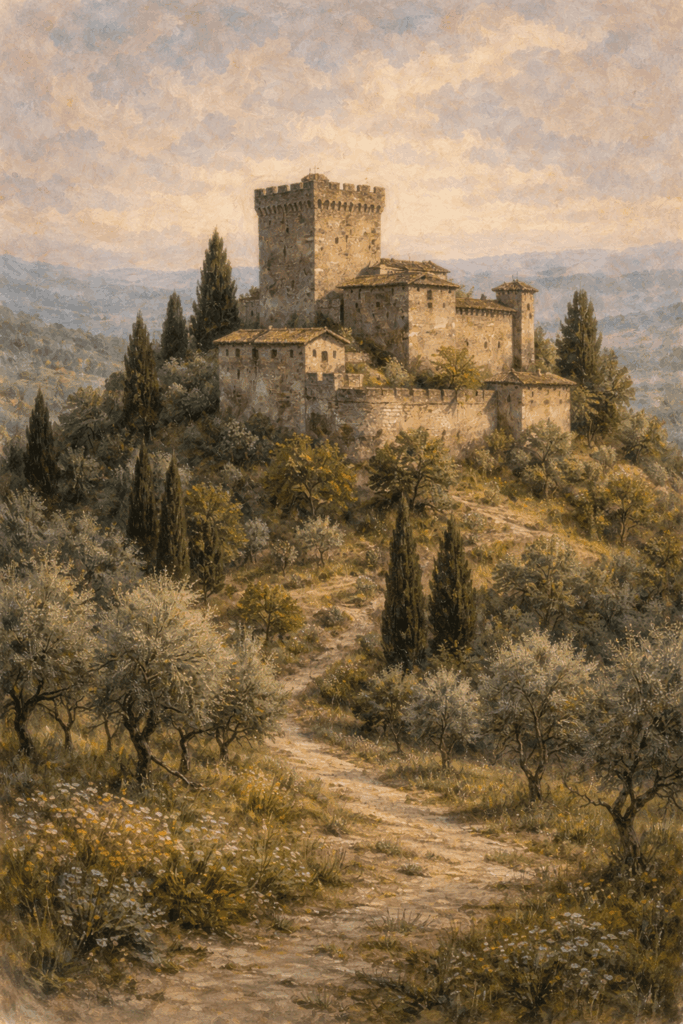
The Battle of Anghiari is more than a historical turning point—it is the source of one of art history’s greatest mysteries: the lost fresco by Leonardo da Vinci, known as the Battle of Anghiari. Set in the heart of Tuscany’s Valtiberina region, this dramatic military conflict and its artistic legacy have captured the imagination of historians, travelers, and art lovers from around the world.
The Real Battle of Anghiari (1440): A Struggle for Tuscany’s Future
On June 29, 1440, the plain below the hill town of Anghiari became the stage for a decisive military confrontation that would determine the political future of central Italy. The Republic of Florence, supported by Papal allies, faced the expansionist army of Duke Filippo Maria Visconti of Milan.
The Florentine victory halted Milan’s ambitions in Tuscany and secured long-term dominance for the Medici family. This success reshaped regional power dynamics and became a foundational moment in Florentine identity—one worthy of monumental artistic commemoration.
Leonardo da Vinci’s Battle of Anghiari: A Lost Fresco and an Enduring Legend
In 1503, the Florentine Republic commissioned Leonardo da Vinci to paint a monumental fresco celebrating the victory in the Salone dei Cinquecento (Hall of the Five Hundred) inside Florence’s Palazzo Vecchio. The resulting work, known as the Battle of Anghiari, was intended to embody Florentine military strength and republican values.
Leonardo chose to experiment with an innovative painting technique inspired by ancient Roman encaustic methods, using heat to fuse pigments to the wall. The experiment failed. The paint began to melt and drip before it could properly set, forcing Leonardo to abandon the project. What remained were only fragments, preparatory drawings, and later copies—yet these suggest a composition of extraordinary intensity.
The most famous section, known as “The Fight for the Standard,” portrayed a ferocious struggle between mounted soldiers locked in violent combat. The scene showcased Leonardo’s unmatched understanding of anatomy, movement, and psychological tension, and is widely considered one of the most powerful battle compositions ever conceived.
The “Cerca Trova” Mystery: Is Leonardo’s Battle of Anghiari Still Hidden?
Several decades later, artist and historian Giorgio Vasari was commissioned to redecorate the same hall. Rather than destroying Leonardo’s work outright, some scholars believe Vasari may have preserved it behind a newly constructed wall.
A crucial clue lies in Vasari’s fresco itself: on a small green banner appear the words “Cerca Trova”—meaning “Seek and you shall find.” This cryptic message has fueled centuries of speculation that Leonardo da Vinci’s Battle of Anghiari fresco may still exist beneath Vasari’s painting.
Modern investigations using infrared scanning and radar technology have detected voids behind the wall, supporting the theory of a hidden layer. Despite ongoing debate and conservation concerns, the possibility that one of Leonardo’s greatest works survives—just out of sight—continues to captivate researchers and visitors alike.
Anghiari Today: Where History, Art, and Legend Converge
Today, the town of Anghiari preserves a powerful connection to its Renaissance past. Its medieval walls overlook the fields where the 1440 battle took place, and the story of Leonardo’s lost masterpiece remains deeply woven into the town’s identity.
Each year, events such as L’Intrepida, a vintage cycling race that follows the historic battle route, transform this legacy into a living celebration. To walk through Anghiari is to stand at the crossroads of history and myth—where a real battle shaped Tuscany, and a lost work by Leonardo da Vinci continues to challenge time itself.